

In an era increasingly dominated by Artificial Intelligence (AI), Machine Learning (ML) stands as the pulsating heart of this technological revolution. From recommending your next favorite song to powering self-driving cars, ML is reshaping how we interact with technology and understand the world. But what exactly is Machine Learning, and how does it work its magic?
Defining Machine Learning: Learning from Data
At its core, Machine Learning is a subset of Artificial Intelligence that enables systems to learn from data without being explicitly programmed. Instead of relying on hard-coded rules, ML algorithms are “trained” on vast amounts of data, allowing them to identify patterns, make predictions, and adapt their behavior over time.
Think of it this way: Traditionally, you’d program a computer with exact instructions to perform a task. With Machine Learning, you provide the computer with data and a goal, and it figures out the instructions (or model) itself. The more data it processes, the better it becomes at its task, much like how humans learn from experience.
The Core Principle: Data-Driven Intelligence
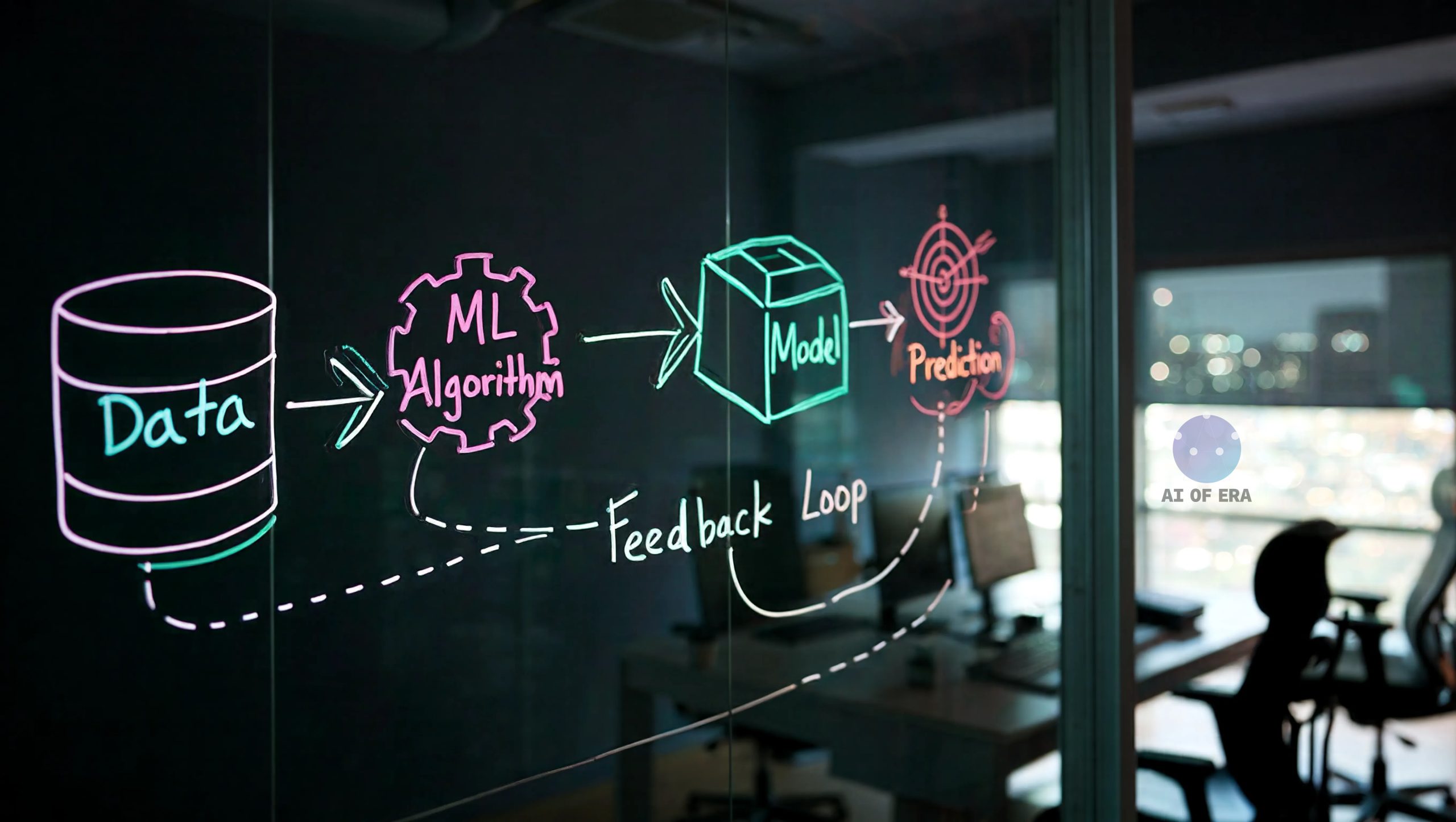
The essence of ML lies in its iterative process:
- Data Input: Feeding relevant data to the algorithm.
- Pattern Recognition: The algorithm analyzes the data to find inherent structures, correlations, or anomalies.
- Model Building: Based on the patterns, a “model” is created or refined. This model is essentially the learned logic.
- Prediction/Decision: The model uses its learned knowledge to make predictions or decisions on new, unseen data.
- Feedback/Improvement: Performance is evaluated, and the model is adjusted to improve accuracy.
The Pillars of Machine Learning: Types of ML
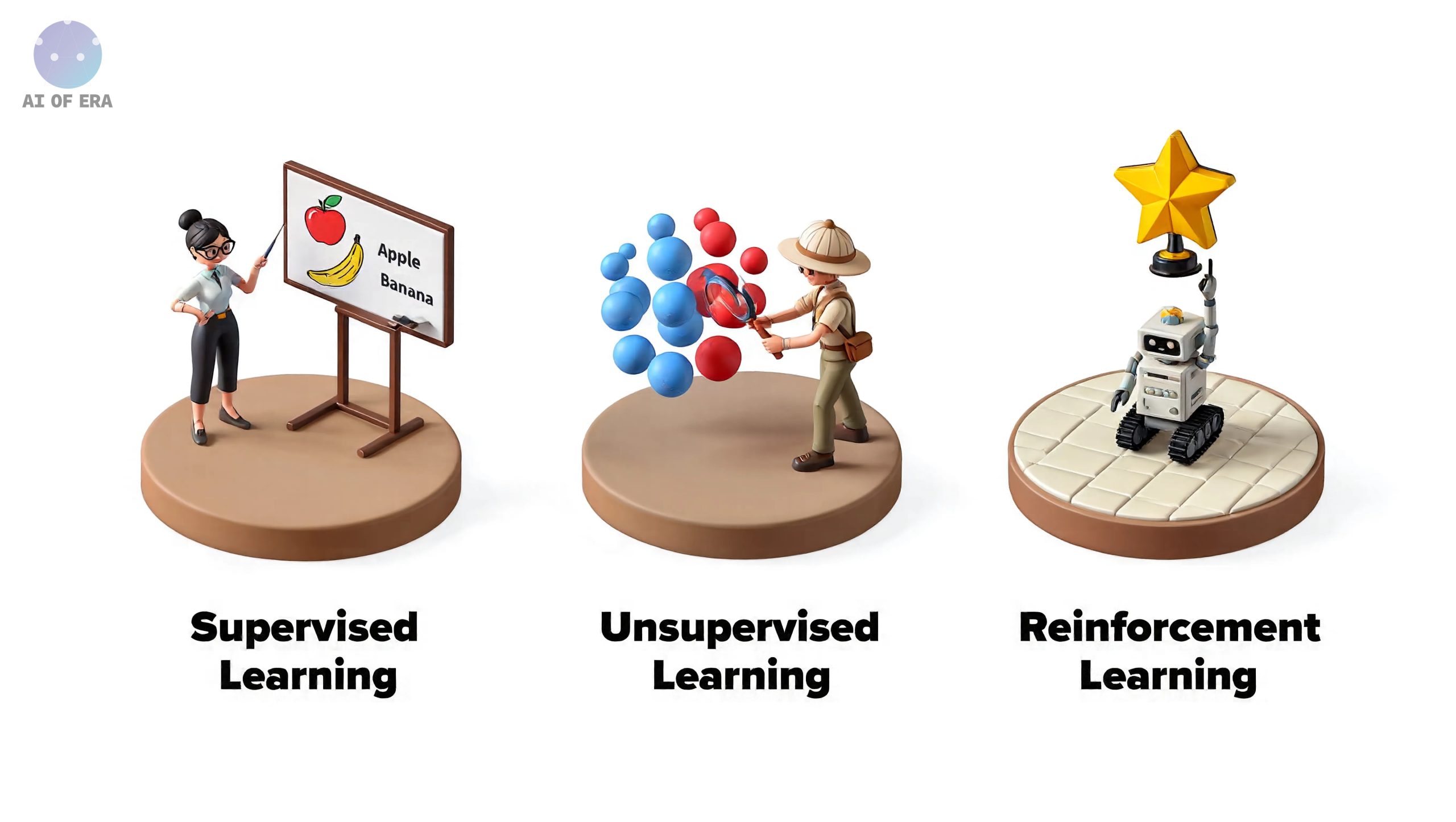
Machine Learning broadly categorizes its learning approaches into three primary types, each suited for different kinds of problems and data.
1. Supervised Learning: Learning with a Teacher
Supervised Learning is the most common type of ML. In this approach, the algorithm is trained on a “labeled” dataset, meaning each piece of input data is associated with a correct output. It’s like learning with a teacher who provides both the problem and the answer.
- How it works: The algorithm learns the mapping from input to output by observing numerous examples. Once trained, it can predict the output for new, unseen inputs.
- Common Tasks:
- Classification: Predicting a categorical label (e.g., spam or not spam, cat or dog, disease or no disease).
- Regression: Predicting a continuous numerical value (e.g., house prices, stock values, temperature).
- Examples: Email spam detection, image recognition, medical diagnosis.
2. Unsupervised Learning: Discovering Hidden Patterns
Unlike supervised learning, Unsupervised Learning deals with “unlabeled” data. Here, the algorithm explores the data to find inherent structures, groupings, or anomalies without any prior knowledge of what the output should be. It’s like exploring a new territory without a map, trying to find interesting landmarks.
- How it works: The algorithm uncovers hidden patterns or intrinsic structures in the data.
- Common Tasks:
- Clustering: Grouping similar data points together (e.g., customer segmentation, document categorization).
- Dimensionality Reduction: Reducing the number of features in a dataset while retaining important information.
- Association: Finding relationships between items (e.g., “customers who buy X also buy Y”).
- Examples: Recommender systems (Netflix, Amazon), market basket analysis, anomaly detection (fraud detection).
3. Reinforcement Learning: Learning by Trial and Error
Reinforcement Learning (RL) is inspired by behavioral psychology. An “agent” learns to make decisions by performing actions in an environment to maximize a cumulative reward. It learns through trial and error, receiving positive rewards for good actions and penalties for bad ones.
- How it works: The agent interacts with its environment, taking actions and observing the consequences. It learns an optimal policy (a set of actions for given states) over time.
- Common Tasks:
- Game Playing: Mastering complex games (e.g., AlphaGo beating the Go world champion).
- Robotics: Teaching robots to navigate and perform tasks in dynamic environments.
- Autonomous Driving: Training self-driving cars to make decisions.
- Examples: Robotic control, personalized content delivery, intelligent traffic light systems.
Why is Machine Learning So Important Today?
The impact of Machine Learning is vast and growing, driven by several factors:
- Abundance of Data: The digital age generates unprecedented volumes of data, which ML algorithms thrive on.
- Computational Power: Advances in hardware (like GPUs) have made complex computations feasible.
- Algorithm Sophistication: ML algorithms have become more powerful and efficient.
- Predictive Analytics: ML enables highly accurate predictions, from sales forecasts to disease outbreaks.
- Automation: Automating repetitive and complex tasks, leading to increased efficiency and reduced human error.
- Personalization: Tailoring experiences for individual users, from content recommendations to customized services.
- Discovery: Uncovering insights and knowledge from data that would be impossible for humans to find.
Real-World Applications of Machine Learning
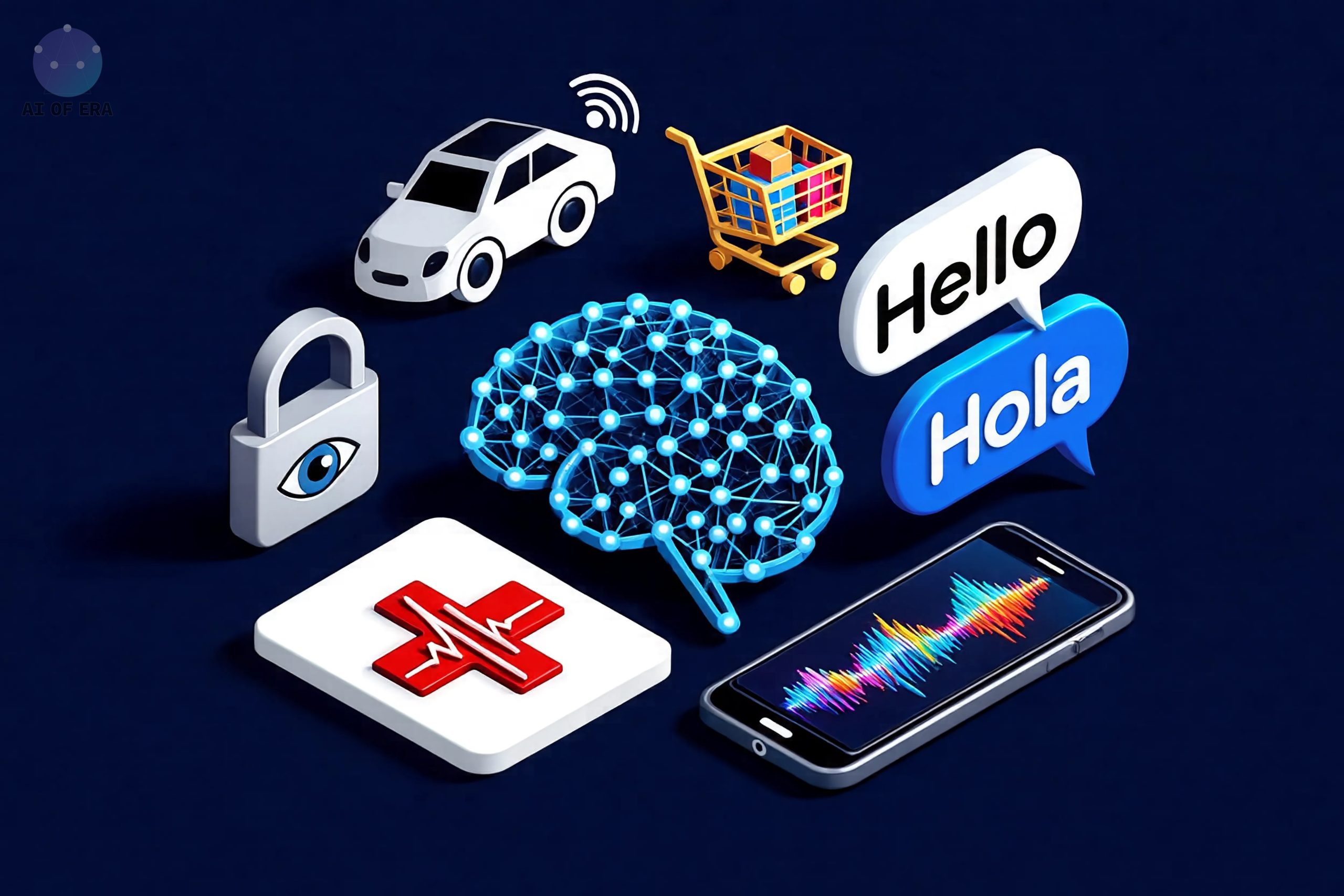
Machine Learning is no longer a futuristic concept; it’s integrated into countless aspects of our daily lives and industries:
- Healthcare: Disease diagnosis, drug discovery, personalized treatment plans.
- Finance: Fraud detection, algorithmic trading, credit scoring.
- E-commerce: Product recommendations, targeted advertising, demand forecasting.
- Transportation: Self-driving cars, traffic optimization, predictive maintenance for vehicles.
- Natural Language Processing (NLP): Voice assistants (Siri, Alexa), language translation, sentiment analysis.
- Computer Vision: Facial recognition, object detection, image classification.
- Social Media: Content moderation, news feed personalization, friend suggestions.
The Road Ahead: Challenges and the Future of ML
While Machine Learning offers incredible promise, it also presents challenges:
- Data Privacy and Security: Protecting sensitive information used in ML models.
- Bias and Fairness: Ensuring algorithms don’t perpetuate or amplify existing societal biases.
- Explainability (XAI): Understanding why an ML model makes a particular decision, especially in critical applications.
- Ethical Considerations: The broader societal impact of autonomous systems.
Despite these challenges, the future of Machine Learning is bright. We can expect continuous advancements in Deep Learning (a subfield of ML involving neural networks), Generative AI (creating new content like images or text), and the integration of ML into more complex, real-world systems, pushing the boundaries of what AI can achieve.
Conclusion: Embracing the ML Revolution
Machine Learning is more than just a buzzword; it’s a transformative technology that empowers computers to learn, adapt, and make intelligent decisions from data. By understanding its fundamental concepts, types, and vast applications, you’re better equipped to navigate and contribute to the exciting future AI holds. Whether you’re a budding data scientist or simply curious about the world around you, the journey into Machine Learning is a fascinating and rewarding one.
